Executive Summary

Wondering how many serums is too many for a single skincare routine? While there’s no strict rule, sticking to one or two targeted serums per routine—and no more than three—gives your skin the best chance to absorb active ingredients without overwhelming your moisture barrier. Stacking multiple potent formulas at once often leads to product pilling, clogged pores, and persistent irritation rather than faster results. In this guide, you’ll learn realistic serum limits for morning and night, five unmistakable signs that your shelf is overloaded, why overlapping actives backfire, and a simple way to pare back your routine without losing progress.
Standing in front of a bathroom mirror lined with five different dropper bottles feels productive until your skin suddenly turns red, tight, and reactive. Social media routines make layering four or five concentrated formulas look effortless, yet real skin rarely thrives under that much daily chemical traffic.
If you’ve ever wondered how many serums is too many, you’re asking one of the smartest questions in skincare. Concentrating too many actives on your face at once doesn’t multiply your results—it multiplies the odds of irritation and wasted product. Below, we’ll break down realistic limits for morning and night, spot the early warning signs of skincare overload, and show you how to simplify your lineup for calmer, healthier-looking skin.
How Many Serums Can You Safely Use in One Routine?

There’s no universal law etched onto skincare bottles, yet most dermatologists and cosmetic chemists agree on a practical sweet spot: one to two serums per routine, with three acting as a firm upper ceiling for resilient skin.
Why cap it there? Every serum you apply adds not just an active ingredient, but also solvents, penetration enhancers, preservatives, and thickeners. By the time you layer a third or fourth bottle, your skin’s surface is saturated, and extra drops mostly sit on top rather than absorbing evenly.
- One serum per routine: Ideal for beginners, sensitive skin types, or anyone using a single high-potency active like a retinoid or exfoliating acid.
- Two serums per routine: The most balanced approach for experienced routines—typically pairing one simple hydrator (like hyaluronic acid) with one targeted treatment (like vitamin C or niacinamide).
- Three serums per routine: Only practical when all three formulas are lightweight, water-based, and non-irritating, such as a soothing humectant, a gentle peptide fluid, and a mild barrier serum.
If you own several serums you genuinely love, split them across your morning and evening routines instead of cramming everything into one sitting. For practical pairing rules, read Can You Use Two Serums in One Routine?.
Five Signs Your Skincare Routine Is Overloaded with Serums
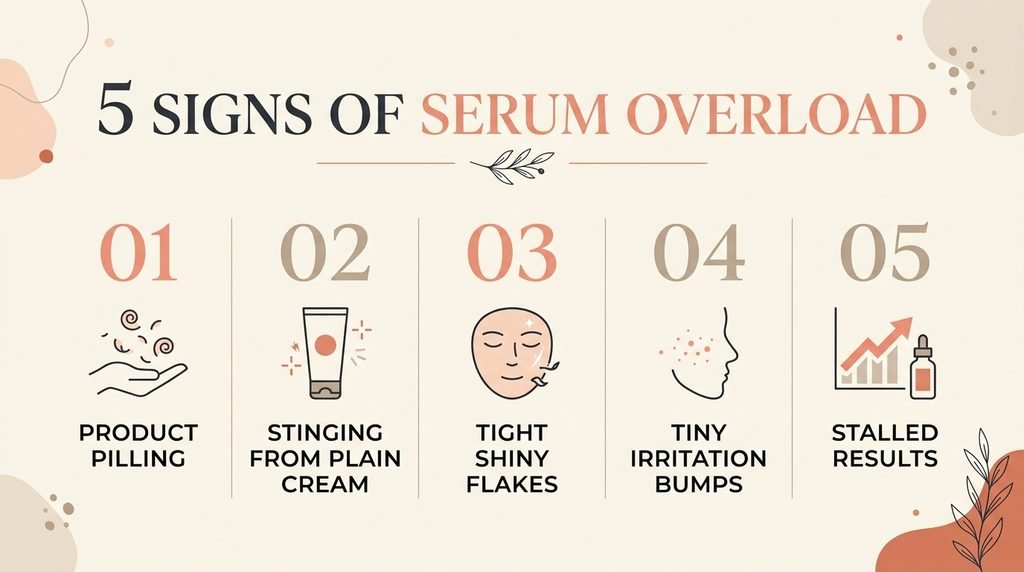
Skin rarely stays silent when you push past its tolerance threshold. Before full-blown sensitivity sets in, your face usually drops subtle hints that your serum lineup needs editing.
- Product pilling when you apply moisturizer or sunscreen: If your skincare rolls up into tiny grey or white balls on your cheeks, your skin has hit saturation point. Too many film-forming polymers and humectants stacked together simply can’t sink in.
- Stinging or burning from plain, bland products: When your everyday gentle cleanser or basic moisturizer suddenly makes your face tingle or flush, your outer moisture barrier is protesting too much active exposure.
- A tight, shiny look paired with dry flakes: Over-layering exfoliating or cell-turnover serums strips away surface lipids, leaving skin looking taut like plastic wrap while still flaking around the nose and mouth.
- Sudden clusters of tiny bumps or congestion: Heavy, multi-serum routines can trap dead skin cells and excess oil, triggering small reactive bumps in spots where you don’t normally break out.
- Zero visible progress after two months: Paradoxically, using four different “brightening” or “smoothing” serums at once often stalls your results because chronic low-grade inflammation keeps skin stressed.
If several of these sound familiar, your barrier likely needs a breather—learn how to spot and address early stress in What Causes a Damaged Skin Barrier.
Why Stacking Multiple Serums Often Backfires

It’s easy to assume that if one brightening serum gives you a 20% boost, three brightening serums will give you 60%. Skin biology doesn’t work like simple addition.
First, overlapping ingredients create hidden overdoses. Many hydrating serums, barrier mists, and moisturizers already include 2% to 5% niacinamide or panthenol. Layering a dedicated 10% niacinamide serum on top of two other products containing the same ingredient pushes your total exposure far higher than intended, raising the risk of flushing and bumps.
Second, pH conflicts and competing actives cancel comfort. Pure L-ascorbic acid requires a low, acidic pH to stay effective, while peptides and niacinamide prefer a more neutral environment. Layering strong acids, retinoids, and low-pH vitamin C back to back forces your skin to work overtime just to rebalance its surface pH.
Finally, dilution reduces effectiveness. Slathering three watery layers onto your face within sixty seconds waters down the active concentration of each formula before it has time to settle into the upper epidermis. One well-formulated serum applied to clean skin consistently outperforms three competing bottles.
Morning vs. Night: Splitting Your Serums Smartly
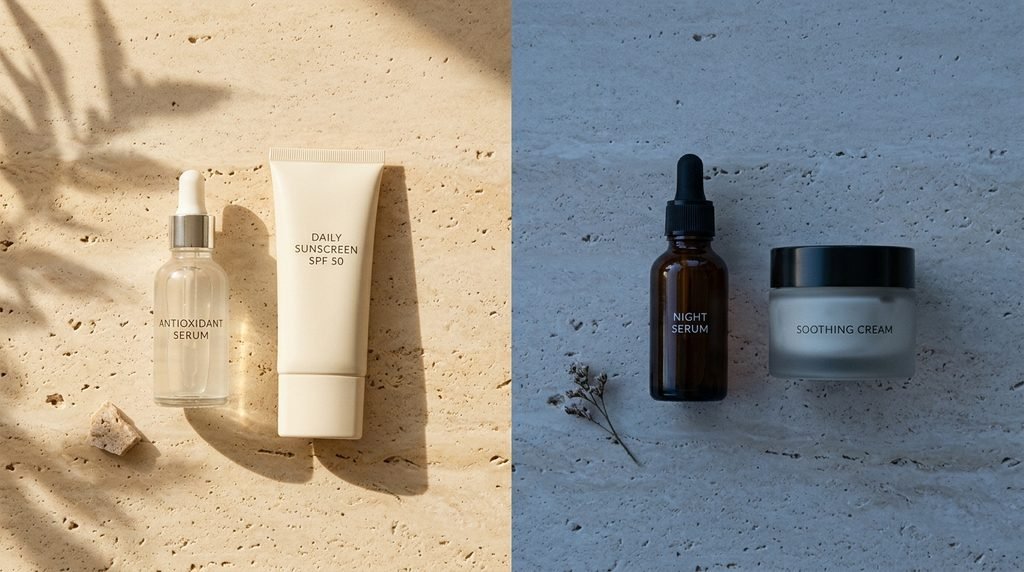
Owning three or four serums isn’t a mistake—trying to wear all of them at the exact same time is. Dividing your bottles between morning defense and nighttime recovery lets you enjoy multiple benefits without overloading a single routine.
| Routine Window | Ideal Serum Limit | Best Types of Serums | What to Leave Out |
| Morning (AM) | 1–2 serums | Antioxidant (vitamin C), lightweight hydrator (hyaluronic acid, glycerin) | Retinoids, strong exfoliating acids (AHA/BHA) |
| Night (PM) | 1–2 serums | Retinoid (retinol, retinal), barrier-repair serum (ceramides, panthenol), or gentle acid | Heavy daytime film-formers that clash with night treatments |
Even better, you don’t have to use the exact same evening serums every night. Alternating nights—such as using a retinoid on Monday and Thursday, an exfoliating acid on Wednesday, and purely hydrating or soothing serums on the remaining nights—gives your skin built-in recovery days.
According to general skincare guidance from the American Academy of Dermatology, keeping routines simple and avoiding simultaneous use of multiple irritating products is one of the most reliable ways to maintain calm, healthy skin.
How to Simplify an Overloaded Serum Routine

If your bathroom counter looks like a beauty store display and your skin feels unpredictable, a short reset will clarify what’s actually helping you.
Step 1: Pause Everything Except Your Core Basics

Set all active serums aside for seven to ten days. Stick strictly to a gentle, fragrance-free cleanser, a plain barrier-supporting moisturizer, and a broad-spectrum sunscreen every morning. This baseline calms surface redness and removes variables.
Step 2: Pick One Primary Goal

Once your skin feels comfortable and balanced again, choose just one top priority for the next month—whether that’s surface dehydration, uneven tone, or rough texture. Pick the single serum in your collection best suited to that goal.
Step 3: Reintroduce One Bottle at a Time

Add that chosen serum back into your routine three times a week, gradually working up to daily use if your skin stays happy. Wait at least two full weeks before deciding whether you even need a second hydrating serum alongside it. For a detailed timeline, see How to Introduce a New Serum and Serum Layering for Sensitive Skin.
FAQ Section

Q: Is it okay to use two serums at once?
A: Yes, using two complementary serums in one routine is completely fine for most skin types. Pairing a simple hydrating serum like hyaluronic acid with one targeted active like vitamin C or niacinamide works well, provided you apply the thinner formula first and give each layer a moment to absorb.
Q: Can I use 3 serums in one routine?
A: You can use three serums in one routine only if all three are lightweight, water-based, and non-irritating—such as a hydrating humectant, a soothing panthenol serum, and a mild peptide fluid. Avoid stacking three strong active serums like exfoliating acids, retinoids, and high-strength vitamin C together.
Q: Can too many serums damage your skin barrier?
A: Yes, layering multiple potent active serums at once can weaken your outer moisture barrier. Over-exfoliation and cumulative irritation strip away protective surface lipids, leading to persistent redness, tightness, flaking, and stinging even when you apply basic, fragrance-free moisturizers.
Q: Is it better to use one serum or several?
A: Using one well-chosen serum tailored to your main skin goal is usually better than layering several overlapping formulas. A single serum absorbs more evenly, avoids ingredient conflicts and product pilling, and makes it much easier to tell whether the formula is genuinely working for your skin.
Q: Can I use two different serums for day and night?
A: Yes, splitting your serums between morning and night is one of the safest ways to get multiple skincare benefits without irritation. Use an antioxidant or hydrating serum in the morning under sunscreen, and save retinoids or exfoliating serums for your evening routine.
Q: Can you mix serums together in a bottle or your palm?
A: Never mix serums together inside a bottle, as this disrupts their preservative systems and pH balance, making them unstable or ineffective. Even mixing drops in your palm isn’t ideal—apply each serum in a thin, separate layer so each formula absorbs properly.
Conclusion

Knowing how many serums is too many protects both your moisture barrier and your wallet. For almost everyone, one or two well-matched serums per routine—split thoughtfully between morning protection and evening repair—delivers smoother, calmer, more consistent results than stacking three or four overlapping bottles at once. When your skin starts pilling, stinging, or breaking out, scaling back is always the smartest move.
Take two minutes tonight to audit your bathroom shelf: group your serums by their main active ingredient, pick one daytime bottle and one nighttime bottle, and give your skin the breathing room it needs to thrive.