Executive Summary
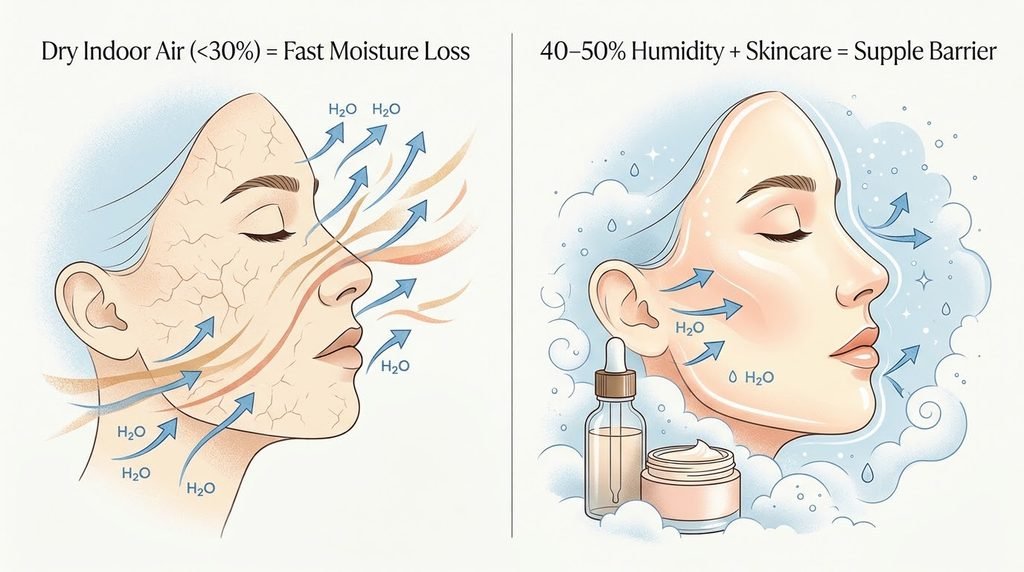
Wondering if using a humidifier for dry skin is actually worth the counter space? Adding moisture to parched indoor air can noticeably reduce surface tightness and flaking, though it works best as a supportive companion to a barrier-friendly skincare routine rather than a standalone fix. When indoor heating or air conditioning strips humidity from a room, water evaporates faster from the top layer of your skin. In this practical, research-grounded guide, you’ll learn how low humidity affects your moisture barrier, what indoor humidity percentage experts recommend, how cool-mist and warm-mist models compare, essential cleaning habits to prevent airborne mold, and how to pair your humidifier with hydrating serums and creams.
When winter heaters kick on or summer air conditioning runs all night, even your richest face cream can suddenly feel like it stops working by morning. You wake up with tight cheeks, flaky patches around your nose, and skin that drinks up moisturizer only to feel dry again an hour later.
If you’ve ever asked yourself, “are humidifiers good for dry skin?” the honest answer is a grounded yes: a humidifier can help reduce moisture loss in dry indoor air, provided you pair it with topical hydration and keep the tank clean. Below, we’ll look at how dry room air pulls water from your skin, the ideal indoor humidity range to aim for, cool versus warm mist options, and simple ways to combine room humidity with your evening skincare routine.
How Dry Indoor Air Affects Your Skin Barrier
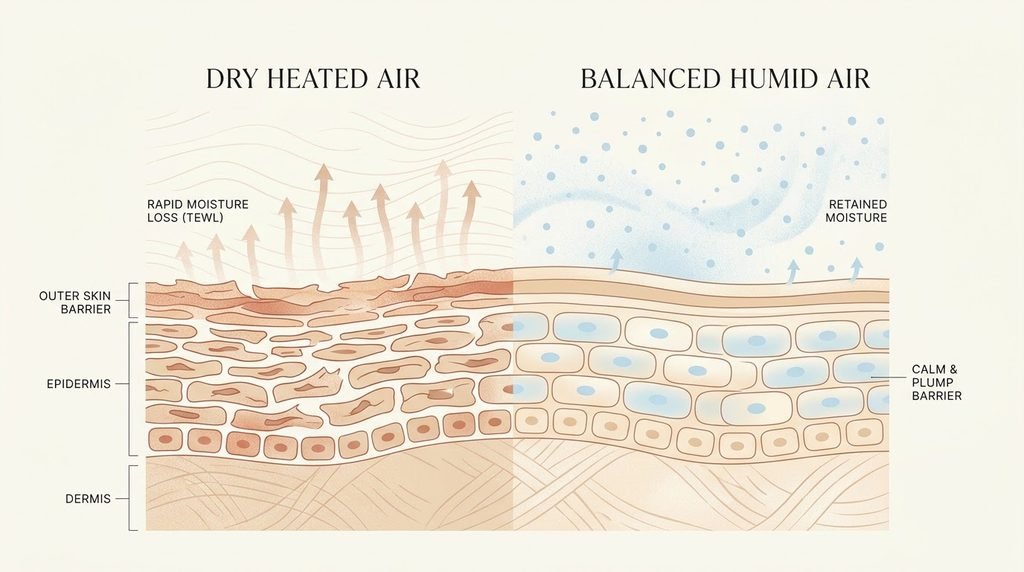
To understand why a bedside humidifier helps, it helps to look at how moisture moves between your skin and the air around you. Your outer skin layer—the stratum corneum—constantly exchanges water vapor with the surrounding environment through a natural process called transepidermal water loss (TEWL).
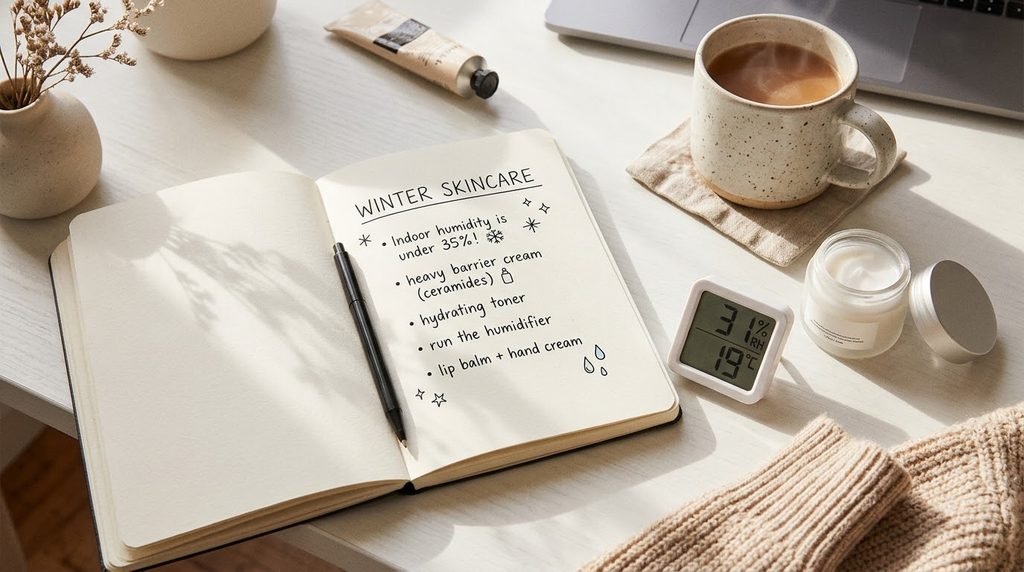
When indoor air is comfortable and moderately humid, that water loss happens at a slow, manageable pace. However, forced-air heating in winter and continuous air conditioning in summer can drop indoor relative humidity well below 30 percent.
In very dry air, moisture evaporates from the surface of your skin much faster than your barrier can replenish it. Over time, that rapid water loss leaves skin feeling papery, tight, and rough, and can weaken your outer lipid barrier. Adding moisture back into the air slows down evaporation, giving your skin a calmer environment to hold onto hydration. For more on how surface water loss differs from a lack of natural oils, read Dehydrated vs. Dry Skin and What Causes a Damaged Skin Barrier.
What Is the Best Indoor Humidity Level for Skin?
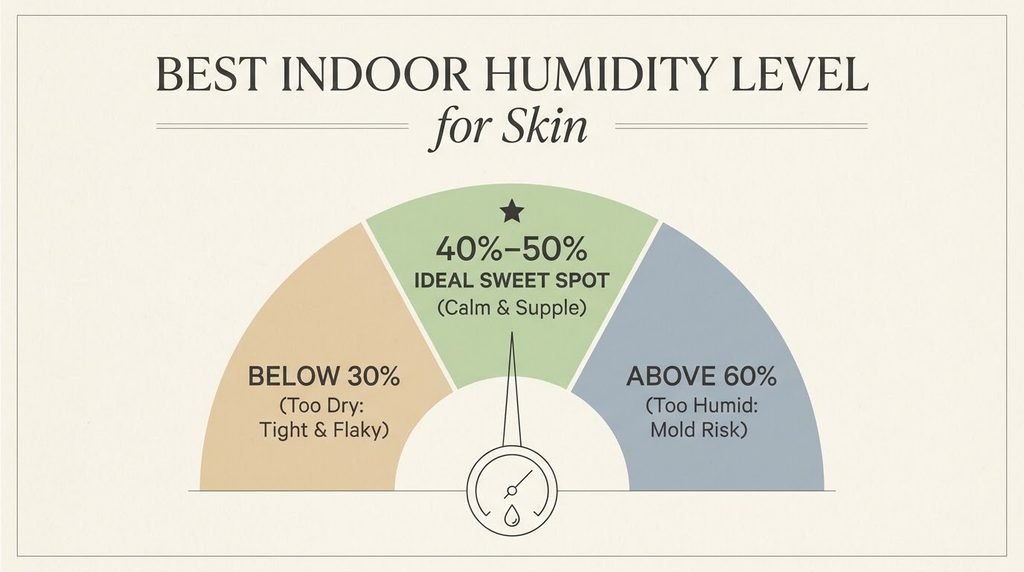
More humidity isn’t automatically better—turning your bedroom into a tropical greenhouse creates its own set of problems. Aiming for a balanced middle ground keeps both your skin and your home comfortable.
According to indoor air quality guidance from the U.S. Environmental Protection Agency (EPA), keeping indoor relative humidity between 30% and 50%—and comfortably below 60%—helps prevent excessive dryness without encouraging dust mites or mold growth. Many dermatology and home-health resources cite 40% to 50% as an ideal sweet spot for dry skin comfort during colder months.
| Indoor Humidity Level | How Your Skin Typically Feels | Home & Air Impact |
| Below 30% (Very Dry) | Tight, itchy, flaky, fine dehydration lines look sharper | Static electricity, dry nasal passages, cracked lips |
| 40% – 50% (Ideal Zone) | Balanced, supple, moisturizer absorbs and lasts comfortably | Comfortable breathing, low risk of mold or condensation |
| Above 60% (Too Humid) | Sticky or clammy; pores may feel congested in warm rooms | Condensation on windows, higher risk of mold and dust mites |
Picking up an inexpensive digital hygrometer (often under ten dollars) lets you check your bedroom’s exact humidity level rather than guessing.
Cool Mist vs. Warm Mist Humidifiers: Which Is Better for Skin?
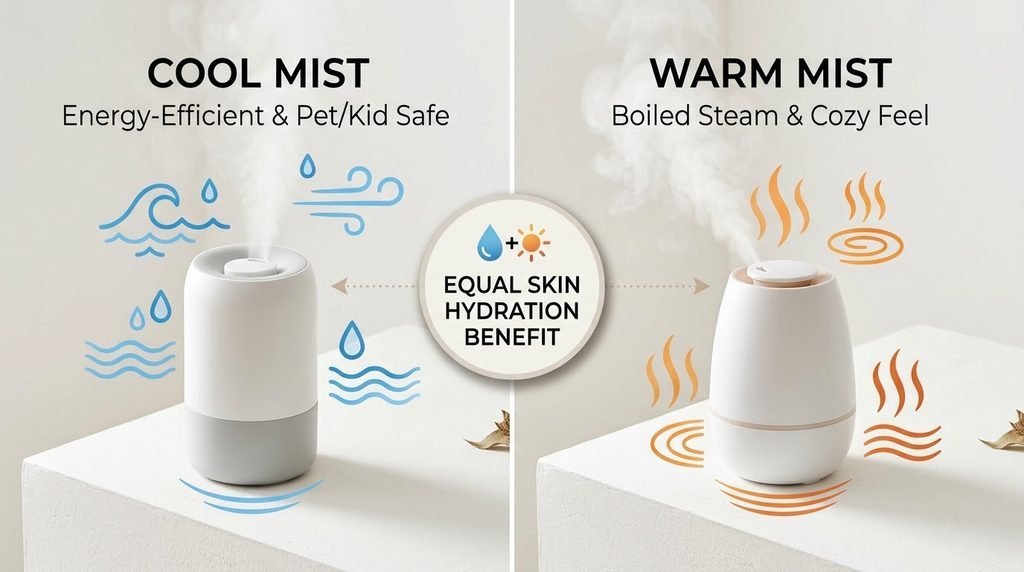
Shopping for a humidifier quickly brings up a classic debate: cool mist or warm mist? When it comes to skin hydration, both deliver essentially the same benefit—once water vapor disperses into your room, it raises ambient humidity at roughly the same temperature.
Choosing between the two comes down to maintenance, safety, and personal preference:
- Cool-mist humidifiers (ultrasonic or evaporative): Release room-temperature water vapor without a heating element. They use less electricity, cover larger bedrooms efficiently, and are much safer around children and pets since there’s no hot water inside. However, ultrasonic models can disperse fine white mineral dust if filled with hard tap water.
- Warm-mist humidifiers (steam vaporizers): Boil water internally to release soothing, slightly warm steam. Boiling naturally kills most waterborne microbes before the mist enters the air, which many people appreciate in cold winter months—though the hot reservoir requires careful placement away from bedsides where it could tip over.
Whichever style you prefer, place the unit at least three to four feet away from your bed and never press your face directly over the mist nozzle, which can over-saturate or irritate sensitive skin.
Why You Still Need Moisturizer (How to Pair Skincare with a Humidifier)
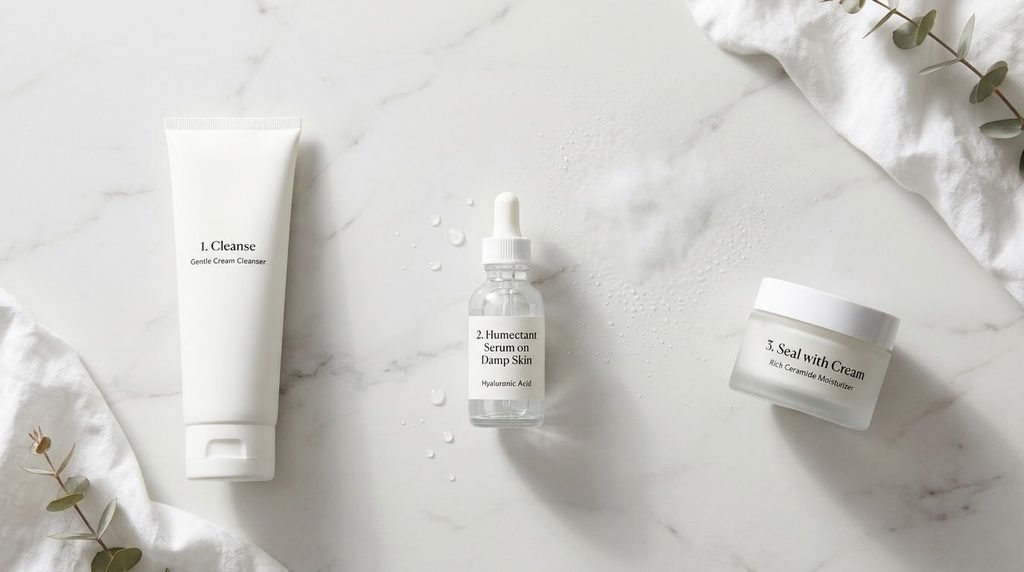
A humidifier changes the air around your face, not the structure of your skin itself. Even if you run a humidifier every night, you still need a topical skincare routine to lock water into the epidermis.
In fact, a moderately humid room makes hydrating skincare work noticeably better. Humectant ingredients like hyaluronic acid and glycerin act like tiny water magnets—in bone-dry air they struggle to find moisture, whereas in a 45% humidity bedroom they draw water cleanly into the upper skin layers.
Simple Evening Routine to Pair with Your Humidifier
- Cleanse gently: Wash with a non-stripping cream or milk cleanser so you don’t remove natural surface lipids before bed.
- Apply a humectant serum on damp skin: Smooth on a hyaluronic acid or glycerin serum right after patting your face so it binds surface water. Learn more in Understanding Hyaluronic Acid.
- Seal with an emollient moisturizer: Follow with a ceramide- or squalane-rich cream to trap hydration inside while your humidifier slows overnight evaporation.
For a full step-by-step morning and night lineup, explore Best Skincare Routine for Dry Skin and How to Care for Dehydrated Skin.
Humidifier Safety and Cleaning: Why Maintenance Matters
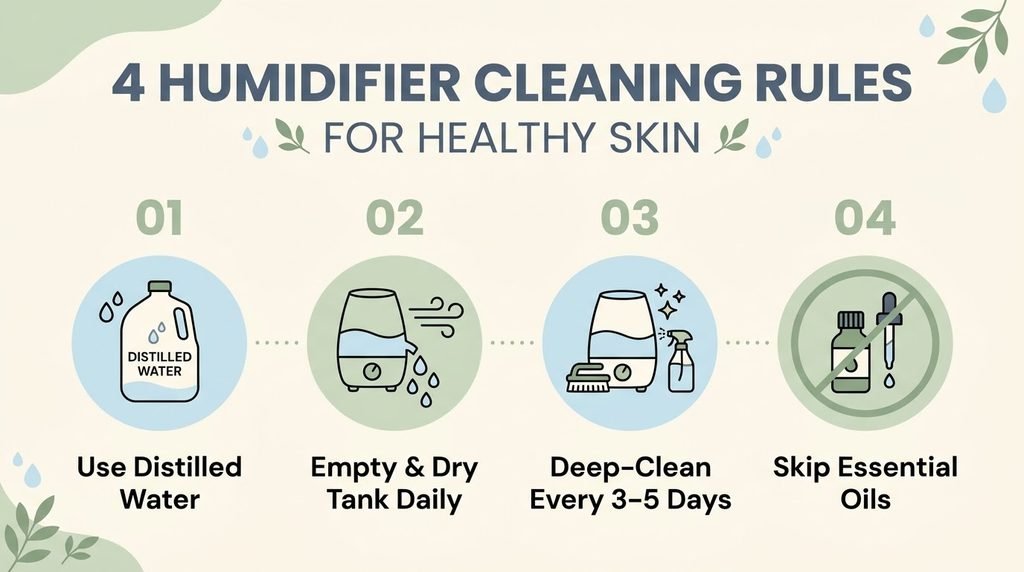
An unclean humidifier can quickly turn from a skin helper into an irritation trigger. Standing water inside a warm tank provides an easy breeding ground for bacteria and mold spores, which get misted directly into the air you breathe and onto your skin overnight.
Follow four simple maintenance habits to keep your air fresh and safe:
- Use distilled or demineralized water: Tap water contains minerals that form crusty scale inside the tank and release fine white mineral dust into your room.
- Empty and dry the tank every morning: Never let leftover water sit stagnant all day—dump it out, rinse the basin, and let it air-dry before refilling at night.
- Deep-clean every three to five days: Follow your manufacturer’s directions (typically using diluted white vinegar or hydrogen peroxide) to remove mineral buildup and sanitize internal surfaces.
- Don’t add essential oils unless designed for it: Essential oils can degrade plastic tanks and release airborne fragrance particles that irritate sensitive or reactive skin.
FAQ Section
Q: Are humidifiers good for dry skin on the face?
A: Yes, humidifiers can help ease dry facial skin caused by indoor heating or air conditioning. Raising room humidity to around 40% to 50% slows water evaporation from the skin’s surface, helping reduce tightness and flaking when paired with a daily moisturizer.
Q: Does sleeping with a humidifier help your skin?
A: Sleeping with a humidifier can noticeably reduce overnight moisture loss, especially in heated winter bedrooms. Running a clean unit a few feet from your bed helps prevent your skin from drying out while you sleep and supports your evening hydrating serum and moisturizer.
Q: Do you still need moisturizer if you use a humidifier?
A: Yes, you still need moisturizer even when running a humidifier. A humidifier adds water vapor to the air around you, while moisturizers provide emollients and ceramides directly on your skin to lock hydration in and reinforce your outer moisture barrier.
Q: Is a cool-mist or warm-mist humidifier better for dry skin?
A: Both cool-mist and warm-mist humidifiers hydrate dry skin equally well because both raise room humidity to similar comfort levels. Cool-mist models are safer around pets and children and use less energy, while warm-mist units boil water first to minimize waterborne microbes.
Q: Can a humidifier make acne or skin worse?
A: A dirty humidifier can irritate skin or worsen congestion if bacteria and mold grow in stagnant tank water and mist into the air. Letting indoor humidity climb above 60% can also make skin feel clammy, so clean your tank regularly and keep humidity near 40% to 50%.
Q: When should you not use a humidifier?
A: Avoid running a humidifier if your room’s humidity already reads above 50% to 60%, if you see condensation forming on windows, or if you haven’t cleaned the tank in several days. Always consult a healthcare professional if you have asthma, severe allergies, or persistent skin conditions.
Conclusion
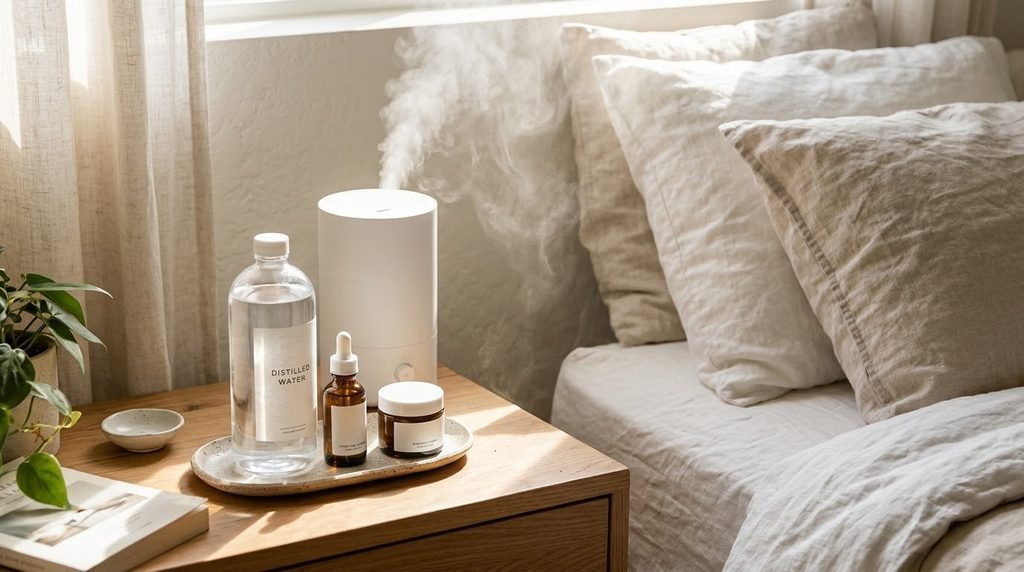
So, are humidifiers good for dry skin? Used thoughtfully, they’re one of the simplest ways to protect your skin from moisture-stripping indoor heating and air conditioning. Keeping bedroom humidity right around 40% to 50% slows overnight water loss, helps humectant serums and moisturizers perform better, and eases winter tightness gradually over a few weeks.
Tonight, set a clean humidifier a few feet from your bed, fill it with distilled water, apply your favorite hydrating serum and ceramide cream before sleep, and wake up to noticeably calmer, more comfortable skin.